Electric-powered air platform concepts from several manufactures are beginning to prove themselves in testing through a wide variety of design platforms. Many that take their lead from traditional drone configurations to multi-engine fan jets that will achieve their flight lift through airplane wing style solutions.
Lilium, which is partly financed by Chinese tech giant Tencent, made the debut flight of its two-seat aircraft in 2017. Further, has performed over 100 vertical take off and landing test with great success with their latest 5 passenger model. Image Credit: China Daily
Air Taxis Are ‘A Thing’ To Be A Real Mobility Option Soon Le paysage des transports prioritaires va changer plus tôt que ne le pensent la plupart des pronostiqueurs.
Les concepts de plates-formes aériennes électriques de plusieurs fabricants commencent à faire leurs preuves lors d'essais sur une grande variété de plates-formes de conception. Nombre d'entre elles s'inspirent des configurations traditionnelles des drones pour créer des avions à réaction multimoteurs dont la portance est assurée par des solutions de type aile d'avion.
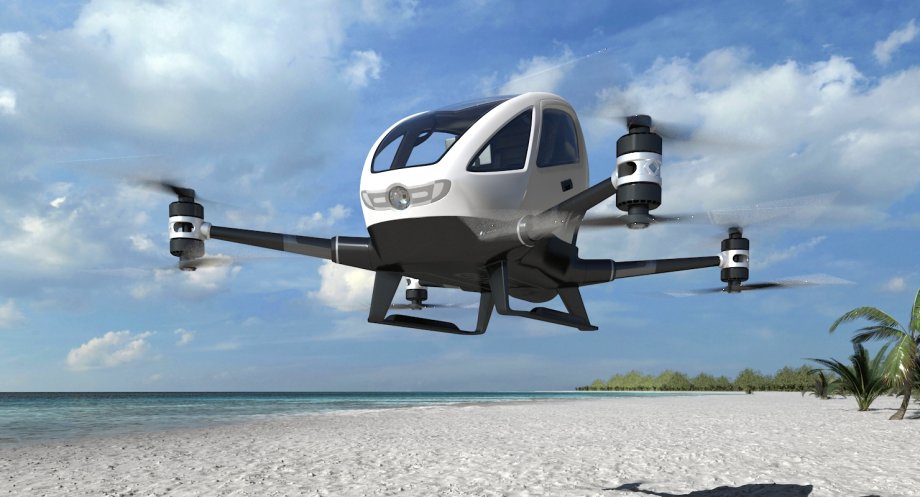
EHang claims its new vehicle, dubbed the 184, is the world’s first electric, personal autonomous aerial vehicle (AAV) that will “achieve humanity’s long-standing dream of easy, everyday flight” for short-to-medium distances. Image Credit: CGStudio
This excerpted and edited from China Daily –
Market for air taxis set to take offBy Angus McNeice in London | China Daily Global | Updated: 2019-10-15 21:07For a show that first aired almost 60 years ago, The Jetsons was impressively prophetic about future technology.The cartoon about a family living in 2062 predicted jetpacks, holograms, smartphones and 3-D printing — and now approximations of the Jetson family’s nifty “aerocar” can be added to the list.Several major transportation businesses, including Boeing, Airbus and Uber, are conducting test flights of all-electric flying machines that promise to revolutionize urban travel through ride-sharing air taxi services.A handful of startups populate the increasingly crowded market, including Volocopter and Lilium, two German companies backed by Chinese investment.Hangzhou-based automaker Geely led a $55 million funding round for Volocopter, which held a demonstration flight for its dronelike passenger carrier in Stuttgart in late September.Lilium, which is partly financed by Chinese tech giant Tencent, made the debut flight in 2017 of its two-seat aircraft, which looks more like a small plane than a helicopter. The company also recently completed a test take-off and landing for a five-seat prototype.The technology is in such an advanced stage that most air taxi companies are predicting commercial launches between 2022 and 2025.--Regulation, costs and public acceptance stand in the way of widespread use of air taxis, according to Tim Schwanen, director of the Transport Studies Unit at Oxford University.“It’s not only about the technology, and in some ways, technology is the easy part,” Schwanen said. “There are issues around regulation, there are issues around markets. Do we want these services? Do we need them?“Visions like The Jetsons where people are flying everywhere, an explosion of flying taxis — that won’t happen for a very long time. We’re talking decades.”
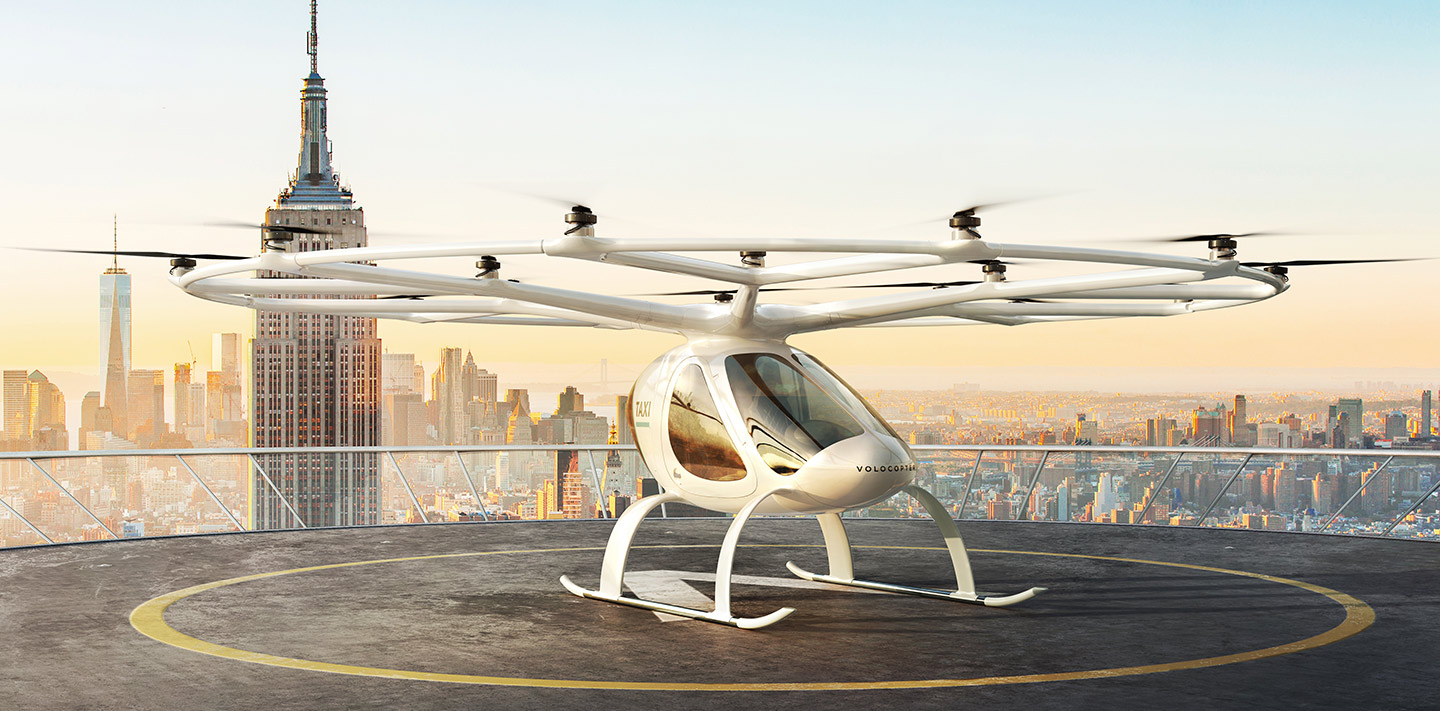
Volocopter GmbH is a German aircraft manufacturer based in Bruchsal and founded by Alexander Zosel and Stephan Wolf. The company specializes in the design of electric multirotor helicopters in the form of ready-to-fly aircraft, designed for air taxi use. Image Credit: Volocopter GmbH
If and how existing air traffic control systems will incorporate air taxis is also a sticking point, as is the limited availability of landing pads in many major cities.A recent report from London-based industry analysts L.E.K. Consulting predicted that a substantial uptake in air taxi services will not occur within the next 10 to 15 years.Whatever the time scale, governments seem to be getting on board with the idea. This year, the United States Federal Aviation Administration expressed support for trials, and the European Union Air Safety Agency published guidelines for manufacturers of electric vertical takeoff and landing, or eVTOL, aircraft.In China, Guangzhou-based air taxi company Ehang began conducting supervised tests with the Civil Aviation Administration of China this year, while Geely’s and Tencent’s investments suggest they believe there is an appetite for the technology in China.Veteran car designer Frank Stephenson, who designs Lilium’s aircraft, said companies must make safety their top priority.“The moment one of these things has an issue, you’re going to lose a lot of public confidence and trust,” he said.Lilium said its service will be affordable, and it expects that early routes will run between airports and city centers.“The intention is absolutely not to make it for the elite,” said Stephenson. “It’s mobility for everyone — from the student or the teenager who needs to visit his grandma … all the way up to the VIP.”Uber predicts its service Uber Air will initially cost $3.60 per passenger kilometer, and the company aims to get this down to $0.27 per passenger kilometer, making it competitive with car ownership.But Schwanen of Oxford University doubts that such low prices will be achievable early on, even in today’s business environment replete with money-losing companies that value growth over profit.Schwanen said he thinks service will be “on a limited scale for the super-rich. It’s going to be people who are able to afford this, and who may have properties where they can land.”Removing pilots from the equation will help drive down costs, and the majority of companies say they will eventually switch to automation.With more than a dozen companies working on air taxis, determining which operators emerge as market leaders will largely come down to design, efficiency and range, according to Stephenson, who believes Lilium is ahead of the pack on all three counts.Lilium says its aircraft will have a range of 300 kilometers, around double the distance offered by most of its competitors.The company also says its planes will use around 90 percent less energy than drone-style aircraft, due in part to wing-assisted flight.The wings on the Lilium plane contain rows of ducted fans mounted in flaps that swivel 90 degrees, pushing air down during takeoff and landing and backward while cruising.“Wings give you lift, so it’s a lot more energy efficient,” Stephenson said.“You need a lot of electrical power to go up and down, but not that much to go horizontally.”Lilium aims to have people in the air by 2025 — outdoing the Jetson family by a generation.
[Reference Here]
Ainsi, la vision du monde futur des Jetson n'est peut-être pas encore là, mais la vision conceptuelle du transport prioritaire pour certaines applications et certains marchés est vraiment à portée de main.
Ce délai de plus de 15 ans se télescopera lorsque les questions de sécurité et d'autonomie seront réglées et qu'il sera possible de monter sur l'une de ces plateformes pour parcourir 150 miles en une heure environ, grâce à des avions à décollage et atterrissage verticaux électriques, ou eVTOL, qui n'ont pas besoin d'être aéroportés et qui peuvent transporter de 1 à 5 passagers.
... notes de The EDJE
TAGS:electric vertical takeoff and landing, eVTOL, aircraft, Lilium, Ehang, Volocopter, L.E.K. Consulting, Frank Stephenson, Geely, Boeing, Airbus, Uber, Tim Schwanen, China Daily, The EDJE














 English
  Deutsch
  Español
  Français
  简体中文
简体中文  Svenska
  Русский
  Português do Brasil
  العربية
  Italiano
  Polski
  日本語
日本語  한국어
한국어  हिन्दी
  Norsk nynorsk
  עִבְרִית
Plus d'histoires
La conception dans la sphère de l'AAM : Euan McPherson, concepteur principal chez Frank Stephenson Design, parle des développements chez AutoFlight
Les équipements de protection individuelle (EPI) pour l'électricité existent - produits par OEL Worldwide Industries (Colorado)
ZeroAvia et flyv s'associent pour proposer des vols propres et à la demande à travers l'Europe
L'onduleur aéronautique de pointe en carbure de silicium de ZeroAvia atteint des performances de premier ordre
L'aéroport régional du Triangle d'Or Mississippi, BETA Technologies et Avflight mettent en place leur premier chargeur électrique en vol
H2FLY And Partners Complete World’s First Piloted Flight of Liquid Hydrogen Powered Electric Aircraft
ASKA A5 Drive & Fly eVTOL Advances FAA Type Certification Process – Prototype Earns Special Airworthiness Certification
Destinus Unveils HydrogenPowered Supersonic Demonstrator Destinus 3 at Paris-Le Bourget Air Show
ZeroAvia At 54th International Paris Air Show At Le Bourget from 19 – 25 June 2023
Eviation Announces MONTE Ordered Thirty All-Electric Alice Aircraft
H2FLY Reaches Milestone In The Further Development Of Its Hydrogen-Electric Powertrain.
Vertical Flight Society Hosts Second Annual Hydrogen Symposium