

Porsche Cayenne Turbo S E-Hybrid Dynamique transversale
The new Porsche Cayenne Turbo S E-Hybrid is not only the fastest and most powerful Cayenne of all time—it also offers a new dimension of transverse dynamic capabilities. The interplay of all chassis innovations makes it particularly fast and agile—performance electrified.
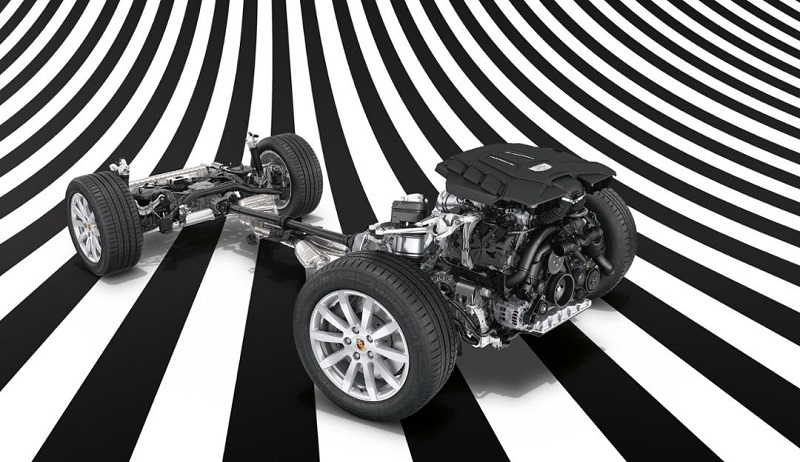 Image Credit: Porsche AG
A drive in the new Cayenne Turbo S E-Hybrid is breathtaking—with a system output of 500 kW (680 hp) (Cayenne Turbo S E-Hybrid: Fuel consumption combined 3.9 – 3.7 l/100 km; CO2 emissions 90 – 85 g/km; electricity consumption (combined) 19.6 – 18.7 kWh/100 km) and a maximum system torque of 900 Nm, it accelerates from 0 to 100 kmh in 3.8 seconds, reaching a top speed of 295 kmh. But the SUV doesn’t just show its abilities on straightaways. It’s extremely stable when cornering and steers agilely. Thanks to numerous adaptive systems, it adjusts to any driving situation and steadfastly holds its course when changing lanes. The Cayenne Turbo S E-Hybrid is capable not only of longitudinal but also lateral dynamics.
“We’ve bundled and perfected all of our previous experience in the new Cayenne.” Project Leader Suspension Model Line SUV
“We’ve bundled and perfected all of our previous experience in the new Cayenne,” says Karl Heeß, Project Leader Suspension Model Line SUV at Porsche. The interplay of the systems significantly increases the performance, driving safety, and comfort of the new Cayenne Turbo S E-Hybrid. Porsche Traction Management (PTM) adaptively controls the distribution of drive power between the front and rear axles according to the driving situation. The three-chamber air suspension can map various spring rates with a very wide spread, depending on whether you’re looking for greater comfort or a sportier driving mode. Porsche Active Suspension Management (PASM) continuously regulates the force of the shock absorbers for each wheel, based on road conditions and driving mode. Porsche Dynamic Chassis Control (PDCC) ensures that the SUV remains horizontal up to a lateral acceleration of 0.8 g when cornering. Porsche Torque Vectoring Plus (PTV Plus) supports steering with targeted braking interventions and provides improved traction when accelerating out of corners, thanks to its fully variable transverse lock. And Porsche 4D Chassis Control connects all of the chassis systems to one another and continuously calculates the optimum driving status information.
The twenty-one-inch wheels, which are standard equipment, support a dynamic driving style. The factory-fitted Porsche Ceramic Composite Brake (PCCB) ensures top braking performance for the most exacting requirements. One useful investment for even more agility and stability is the optional rear-axle steering. Not only does it reduce the turning circle from 12.1 to 11.5 meters by steering three degrees, it also steers the rear wheels up to 80 kmh in the opposite direction from the front axle for greater maneuverability and precision. When driving fast straight ahead, the rear-axle steering has a stabilizing effect, steering parallel to the front wheels up to the final speed, for example, when changing lanes on the freeway. The Cayenne’s front axle therefore doesn’t have to pull the rear axle around—it actively shapes the directional movement. As a result, the Cayenne is able to implement its high system power by combining combustion engine and electric motor safely and efficiently. And what’s the result of all this engineering? In a nutshell, Karl Heeß says, “When you drive the Cayenne Turbo S E-Hybrid, you think you’re sitting in a classic sports car.”
45.5%
of the vehicle weight on the Cayenne Turbo S E-Hybrid rests on the rear axle. The distribution is even more balanced, which benefits the lateral dynamics.
245 to 162 mm
of ground clearance are offered by the three-chamber air suspension. In conjunction with Porsche Active Suspension Management (PASM), the hardness and height of the chassis are adapted to the ground and the situation.
Up to 0.8 g
of lateral acceleration and the resulting body roll are compensated for by the electromechanical Porsche Dynamic Chassis Control (PDCC).
11.5 meters
is the turning circle with rear-axle steering, as opposed to 12.1 meters without it. In addition, the combination with Porsche Torque Vectoring Plus (PTV Plus) provides even more agile steering and greater driving stability at high speeds.
50 %
is the weight savings on the brake disks thanks to Porsche Ceramic Composite Brakes (PCCB).
4D
Porsche 4D Chassis Control enables the chassis systems to act in concert and proactively in anticipation of the driving situation ahead.










 English
  Deutsch
  Español
  Français
  简体中文
简体中文  Svenska
  Русский
  Português do Brasil
  العربية
  Italiano
  Polski
  日本語
日本語  한국어
한국어  हिन्दी
  Norsk nynorsk
  עִבְרִית
Plus d'histoires
Alors que le marché des véhicules électriques reste prudent, l'IA agentique dans les véhicules est la prochaine frontière.
L'Alfa Romeo Tonale met le "S" dans SUV
INDY Autonomous Challenge - CES2025 - Les pilotes IA font la course avec cinq dépassements en vingt tours.
L'avenir de l'IA physique présenté avec des courses de voitures et des collaborations révolutionnaires L'Indy Autonomous Challenge revient au CES le 9 janvier 2025
La Polestar 3 Long Range Single Motor démarre sa production aux États-Unis avec une autonomie certifiée de 350 miles (EPA)
Un nouveau langage de conception Hyundai Motor dévoile un concept FCEV à hydrogène audacieux et efficace
Electrify America inaugure un campus technologique élargi
Le GMC Sierra EV Denali 2025 offre plus d'autonomie et plus de choix
L'avenir de la performance intelligente Lotus dévoile la théorie 1
L'Indy Autonomous Challenge organise un sommet sur l'IA et l'automatisation à l'Indianapolis Motor Speedway
Le tout nouveau modèle conceptuel Acura entièrement électrique sera présenté à la Monterey Car Week
Polestar livre les premiers SUV électriques Polestar 3 à ses clients