


Image Credit Uber, Hyundai
Uber And Hyundai Motor Announce Aerial Ridesharing Partnership, Release New Full-Scale Air Taxi Model At CES
- Hyundai is the first Uber Elevate partner with manufacturing capabilities to mass produce Uber Air Taxis
- Hyundai’s UAM (Urban Air Mobility) will vitalize cities by enabling on-demand urban air mobility in Uber’s Elevate Network
Uber and Hyundai Motor Company have today announced a new partnership to develop Uber Air Taxis for a future aerial ride share network and unveiled a new full-scale aircraft concept at the Consumer Electronics Show (CES). Hyundai is the first automotive company to join the Uber Elevate initiative, bringing automotive-scale manufacturing capability and a track record of mass-producing electric vehicles. The air vehicle concept Hyundai released today was created in part through Uber’s open design process, a NASA-inspired approach that jump-starts innovation by publicly releasing vehicle design concepts so any company can use them to innovate their air taxi models and engineering technologies.
In this partnership, Hyundai will produce and deploy the air vehicles, and Uber will provide airspace support services, connections to ground transportation, and customer interfaces through an aerial ride share network. Both parties are collaborating on infrastructure concepts to support take-off and landing for this new class of vehicles.
“Our vision of Urban Air Mobility will transform the concept of urban transportation,” said Jaiwon Shin, Executive Vice President and Head of Hyundai’s Urban Air Mobility (UAM) Division. “We expect UAM to vitalize urban communities and provide more quality time to people. We are confident that Uber Elevate is the right partner to make this innovative product readily available to as many customers as possible.”
“Hyundai is our first vehicle partner with experience of manufacturing passenger cars on a global scale. We believe Hyundai has the potential to build Uber Air vehicles at rates unseen in the current aerospace industry, producing high quality, reliable aircraft at high volumes to drive down passenger costs per trip. Combining Hyundai’s manufacturing muscle with Uber’s technology platform represents a giant leap forward for launching a vibrant air taxi network in the coming years,” said Eric Allison, head of Uber Elevate.
In preparation for this announcement, Hyundai has worked with Uber Elevate to develop a PAV (Personal Air Vehicle) model, S-A1, that utilizes innovative design processes to optimize electric vertical take-off and landing (eVTOL) aircraft for aerial ridesharing purposes. The Elevate initiative based this process on NASA’s historical approach of putting design concepts out publicly to inspire innovation amongst multiple companies, spurring the development of common research models to investigate novel aerodynamic concepts and catalyzing industry progress in wing design, noise, aerodynamics, and simulation verification.
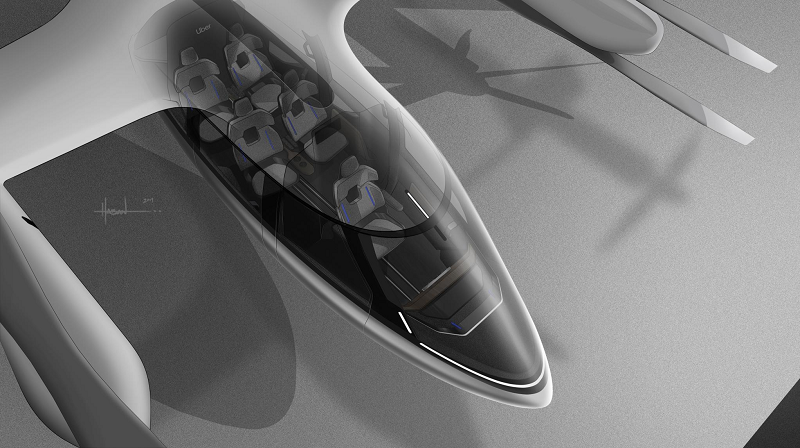


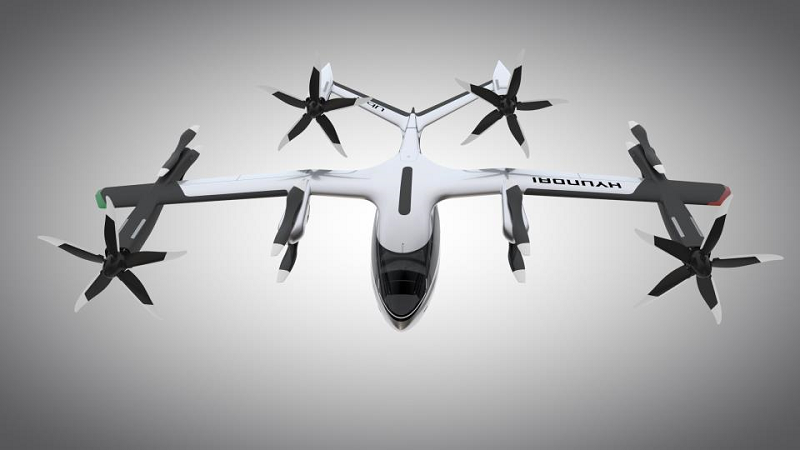


Image Credit Uber, Hyundai
As a result, Hyundai’s S-A1 model unveiled at CES reflects previous eVTOL designs Uber Elevate has released in the following ways:
- It is designed for a cruising speed up to 180 miles/hr (290 km/hr), a cruising altitude of around 1,000-2,000 feet (300 – 600 mt) above ground, and to fly trips up to 60 mile (100 km).
- The Hyundai vehicle will be 100% electric, utilizing distributed electric propulsion and during peak hours will require about five to seven minutes for recharging.
- Hyundai’s electric aircraft utilizes distributed electric propulsion, powering multiple rotors and propellers around the airframe to increase safety by decreasing any single point of failure. Having several, smaller rotors also reduces noise relative to large rotor helicopters with combustion engines, which is very important to cities.
- The model is designed to take off vertically, transition to wing-borne lift in cruise, and then transition back to vertical flight to land.
- The Hyundai vehicle will be piloted initially, but over time they will become autonomous.
- The cabin is designed with four passenger seats, allowing riders to board / disembark easily and avoid the dreaded middle seat with enough space for a personal bag or backpack / rider.
Ushering in the era of seamless mobility, Hyundai’s exploration of future urban transportation incorporates the electric PAV concept with a new ground transportation, the Purpose Built Vehicle (PBV) concept. Hyundai’s vision for creating communities from future transit systems comes into focus with yet another new infrastructure concept, called the Hub. When many PBVs and PAVs are docked and connected to a Hub, they make a new public space where diverse groups of people can come together.
Hyundai Motor’s innovative smart mobility solutions including UAM, PBV, Hub and more will be showcased at Hyundai’s CES booth in Las Vegas Convention Center North Hall, Booth 5431.



































その他のストーリー
スカイドライブコンパクトなeVTOLで空の旅のアクセシビリティを高める
ホライズンAAMハイブリッド電気カボライトX7機が歴史的な前進飛行への移行を達成
JetsonとEuroSets、eVTOL技術と先進医療ソリューションで緊急UAM対応に革命を起こし、人命を救う
UAMのeVTOLエアレースの未来は、大胆な一歩を踏み出した
AAM圏のデザイン:フランク・スティーブンソン・デザインのシニアデザイナー、ユアン・マクファーソンがオートフライトの開発について語る
BETA、ユタ州全域で飛行デモンストレーションを完了
ALEF - 空飛ぶクルマ:都市モビリティの未来を拓く
新会社ゴーヴ、空飛ぶクルマの実現に向けた取り組みを開始
ジェットソン、世界初の有人eVTOLエアレース試験で敏捷性の限界を試す!
コロラド州を拠点とするOEL Worldwide Industriesが製造する電気式個人用保護具(PPE) - Electrical Personal Protective Equipment (PPE) Is A Thing - Produced by Colorado Based OEL Worldwide Industries
イヴ、eVTOL開発のため$5億円の融資を受ける
Supernal、オペレーターおよびネットワークモデルの検討でBladeと提携