
New Hybrid Technology To Prevent Icing On Aircraft and Drones
The testing conducted at NASA’s Icing Research Tunnel has moved the hybrid technology to a readiness level of 6 (TRL6).
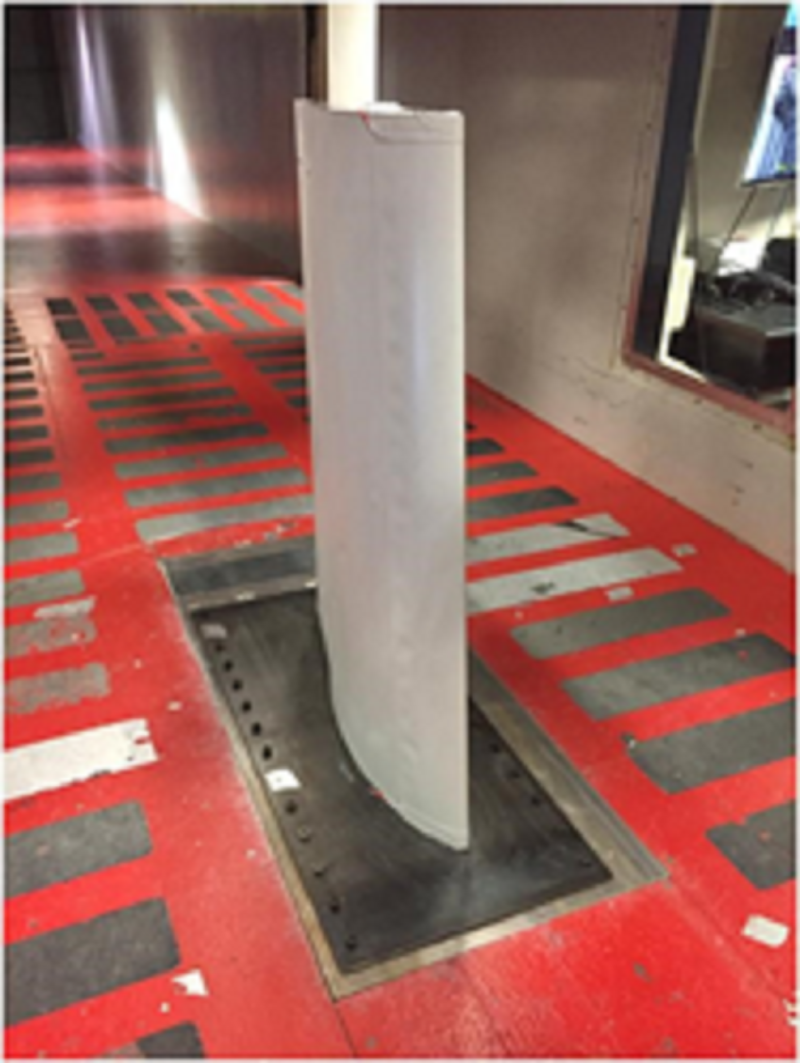 Image Credit: NEI Corporation
Invercon and NEI Corporation’s newly developed de-icing system tested successfully at NASA’s Icing Research Tunnel and was advanced to a Technology Readiness Level of 6. The hybrid technology is designed to prevent ice accretion on aircraft and drones.
Invercon Inc. and NEI Corporation have recently announced that their newly developed de-icing system was tested successfully at the NASA Glenn Research Center’s Icing Research Tunnel. The test was witnessed by engineers and scientists at the Research Center, as well as from the industry. The Invercon-NEI team met the objective of demonstrating a low power anti-ice system in conjunction with NEI’s NANOMYTE® SuperAi anti-ice coating that prevents ice accretion on the leading edge of an airfoil. The test was performed on a full-size airfoil under simulated in-flight conditions, following nearly two years of development and laboratory testing.
All commercial aircraft have a built-in ice protection system, which could be either a thermal, thermo-mechanical, electro-mechanical, or pneumatic system. A common issue with de-icing devices is that they consume substantial power. Aircraft generally look to reduce power consumption, and with the advent of battery-powered aircraft, mechanisms or features that reduce power consumption are critically important. Icing presents a particular challenge for commercial and military drones, where ice can build up on the wings and propellers and result in crashes. In fact, the current practice is not to fly drones when icing conditions are predicted. Applying a passive anti-ice coating that functions synergistically with an active de-icing device is an attractive hybrid approach, which the team of NEI and Invercon has now demonstrated on full-scale prototypes.
NEI’s NANOMYTE® SuperAi anti-ice coating is a durable coating, suitable for permanent application. The coating leads to a lubricating surface that drastically reduces the adhesion strength of ice – by as much as 80%, compared to bare polished aluminum. The coating is usually applied by spraying, like conventional painting. NANOMYTE® SuperAi coating is available for commercial use.
Invercon has developed a new, retrofittable, electro-pneumatic deicing system that combines the most attractive aspects of several existing systems without their associated drawbacks. The Invercon system requires remarkably low power (≤ 2.5 kW), is retrofittable on any airfoil, adds very little weight (~50 lbs.), and is durable enough to last the life of the aircraft once retrofitted. Importantly, the system looks, feels, and acts like the original leading edge and can provide millions of maintenance-free deicing cycles. The entire wing test section (Figure 1) was coated with NANOMYTE® SuperAi.
Invercon successfully completed icing tests of the electro-pneumatic deicing system at NASA Glenn’s Icing Research Tunnel (IRT) under a full range of representative icing conditions. The Invercon system was able to provide continuous deicing of the wing section leading edge over all the test conditions ranging from temperatures of -3°C to -20°C with various liquid water content. Typically, the system allows ice to accrete for about 2 minutes and then completely sheds upper and lower surface ice upon system activation.
The testing at NASA’s IRT, which is the longest running icing facility in the world, has moved the hybrid technology to a readiness level of 6 (i.e., TRL6), which is a scale used by NASA and Department of Defense to gauge the maturity level of a technology.
Both NEI Corporation and INVERCON LLC are grateful for the financial support extended by the Small Business Innovation Research Program from the Air Force and NASA. The SBIR program funds product development efforts that reduce concepts to practice and then to prototypes, thereby reducing technology risk. The successful full-scale demonstration by the team has advanced a new technology to a state of commercial readiness.
について NEI Corporation:
NEI Corporation is an application-driven company that utilizes nanotechnology to develop and produce advanced materials. The company’s core competencies are in synthesizing nanoscale materials and prototyping products that incorporate the advanced materials. NEI offers an array of Advanced Protective Coatings for metal and polymer surfaces. The coatings have tailored functionalities, such as anti-corrosion, self-healing, scratch resistance, ice-phobic, and self-cleaning.
について Invercon LLC:
Invercon’s mission is to develop advanced technologies that enable revolutionary leaps forward in aircraft performance and safety. For rotorcraft, these include centrifugally powered, pneumatic actuation systems that can actively trim rotors and de-ice rotor blades using almost no power or weight, resulting in significantly improved performance and safety. For fixed wing aircraft, Invercon has developed extremely low power deicing solutions using a novel electro-pneumatic actuation approach.











 English
  Deutsch
  Español
  Français
  简体中文
简体中文  Svenska
  Русский
  Português do Brasil
  العربية
  Italiano
  Polski
  日本語
日本語  한국어
한국어  हिन्दी
  Norsk nynorsk
  עִבְרִית
その他のストーリー
AAM圏のデザイン:フランク・スティーブンソン・デザインのシニアデザイナー、ユアン・マクファーソンがオートフライトの開発について語る
コロラド州を拠点とするOEL Worldwide Industriesが製造する電気式個人用保護具(PPE) - Electrical Personal Protective Equipment (PPE) Is A Thing - Produced by Colorado Based OEL Worldwide Industries
GENIUS NY、ドローンスタートアップに$3百万ドルを投資
2024年11月25日-27日に開催されるDronetech Asiaの国際会議でドローンアプリケーションの未来を探る
パラレル・フライト・テクノロジーズ社、アルファ・ドローン社からハイブリッド型ヘビーリフトUAV「ファイアフライ」を複数台受注
ZeroAviaとflyv、欧州全域のクリーンなオンデマンド・フライトで提携
ZeroAvia最新鋭の炭化ケイ素製航空インバーターが世界最高水準の性能を発揮
ゴールデン・トライアングル・リージョナル空港、ミシシッピ州、BETAテクノロジーズ社、Avflight社が同社初の電気式エアサイド充電器を設置
H2FLY社とパートナー、液体水素を動力源とする電気航空機の世界初のパイロット飛行を完了
ASKA A5 Drive & Fly eVTOL、FAA型式証明を取得 - プロトタイプが特別耐空証明を取得
Destinus Unveils HydrogenPowered Supersonic Demonstrator Destinus 3 at Paris-Le Bourget Air Show
ZeroAvia At 54th International Paris Air Show At Le Bourget from 19 – 25 June 2023