

Hyundai und Kia entwickeln weltweit erstes ICT Connected Shift Technology System
- Information and communication technology (ICT) automatically shifts to optimal gear based on road and traffic conditions ahead
- Improves driving comfort and fuel efficiency by minimizing unnecessary shifts through predictive gear-shifting control system
- Future developments to include consideration of driver’s preferences and traffic signal status
Hyundai Motor Company and Kia Motors Corporation announced today that they have developed the world’s first predictive Information and Communication Technology (ICT) Connected Shift System, enabling the vehicle to automatically shift to the optimal gear after identifying the road and traffic conditions ahead. Hyundai and Kia plan to apply the technology on future vehicles. During system development, the companies filed about 40 major patents in South Korea and abroad.

 Image Credit: Hyundai Media
While the technologies used to automatically shift depend on drivers’ preferences, such as Smart Drive Mode – available on most current Hyundai and Kia models – ICT Connected Shift System is the first ICT to automatically shift the gear according to road and traffic conditions.
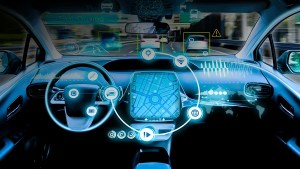
ICT Connected Shift System uses intelligent software in the Transmission Control Unit (TCU) that collects and interprets real-time input from underlying technologies, including 3D navigation equipped with a precise map of the road as well as cameras and radar for smart cruise control. The 3D navigation input includes elevation, gradient, curvature and a variety of road events as well as current traffic conditions. Radar detects the speed and distance between the vehicle and others, and a forward-looking camera provides lane information.
Using all of these inputs, the TCU predicts the optimal shift scenario for real-time driving situations through an artificial intelligence algorithm and shifts the gears accordingly. For example, when a relatively long slowdown is expected and radar detects no speed irregularities with the car ahead, the transmission clutch temporarily switches to neutral mode to improve fuel efficiency.
When Hyundai and Kia tested a vehicle with an ICT Connected Shift System on a heavily curved road, the frequency of shifts in cornering was reduced by approximately 43 percent compared to vehicles without the system. Accordingly, the system also reduced the frequency of brake operation by approximately 11 percent, thereby minimizing driving fatigue and brake wear.
When rapid acceleration was required to enter a highway, the driving mode automatically switched to Sport Mode at the merge, making it easier to join the traffic flow. After merging with traffic, the vehicle automatically returned to its original driving mode, enabling safe and efficient driving.
In addition, the engine brakes were automatically applied upon release of the accelerator pedal by determining speed bumps, downhill slopes and location of the speed limit change on the road. The changes in distance from the front car were detected by the front radar to adjust appropriate transmission gear automatically, which improved driving quality.
The system is also in line with autonomous technology, which is developing day by day. The ICT Connected Shift System will deliver both improved fuel efficiency and a stable driving experience in the era of autonomous vehicles by providing improved performance in response to real-time road and traffic conditions.
Hyundai and Kia are planning to further develop the ICT Connected Shift System into an even more intelligent transmission technology that can communicate with traffic signals based on LTE or 5G communication and identify drivers’ tendencies, resulting in further refinement of gear-shift control.
“Vehicles are evolving beyond simple mobility devices into smart mobility solutions,” said Byeong Wook Jeon, Head of Intelligent Drivetrain Control Research Lab. “Even a traditional area of the automobile, such as the powertrain, is becoming a high-tech technology optimized for smart mobility through efforts to integrate ICT and artificial intelligence technologies.”













 English
  Deutsch
  Español
  Français
  简体中文
简体中文  Svenska
  Русский
  Português do Brasil
  العربية
  Italiano
  Polski
  日本語
日本語  한국어
한국어  हिन्दी
  Norsk nynorsk
  עִבְרִית
Mehr Geschichten
Alfa Romeo Tonale setzt das "S" in SUV
Flüssiger Wasserstoff ist die Energiequelle der Rennstrecke Ziel der Mission H24
The New Continental GT Speed Debuts At Goodwood Goodwood’s Festival of Speed
Porsche Taycan Turbo GT und Taycan Turbo GT mit Weissach-Paket erzielen Rekordzeiten in Laguna Seca und auf dem Nürburgring
Porsche stellt zwei neue Panamera-Varianten 4 E-Hybrid und 4S E-Hybrid für das Modelljahr 2025 vor
#CES2024 Reveal Of eVTOL XPENG Flying Car
Lamborghini LB744 ist der neue Maßstab für Hybrid-Supersportwagen
Die ersten Czinger-Fahrzeuge und das 21C-Hybridauto
Volvo Cars stellt überarbeitete Modelle S90 und V90 mit Mild-Hybrid-Antrieb für die gesamte Baureihe vor
Karma Automotive debütiert in Europa auf dem Genfer Automobilsalon 2020
Die Produktion des Chiron geht in die zweite Hälfte
Das neue elegante, kraftvolle und elektrisch angetriebene Mercedes AMG GLE 63 S Coupé