

The ZHAW School of Engineering conducted electric vertical take-off and landing (eVTOL) flight tests to validate its VTOL digital twin model, aiming to streamline the development of future eVTOL aircraft.
Image Credit: AAM International Media
Story By William Mackenzie
The Zurich University of Applied Sciences (ZHAW) School of Engineering has collaborated with Aurora Swiss Aerospace to validate its vertical take-off and landing (VTOL) digital twin model, which aims to streamline the development of eVTOL aircraft.
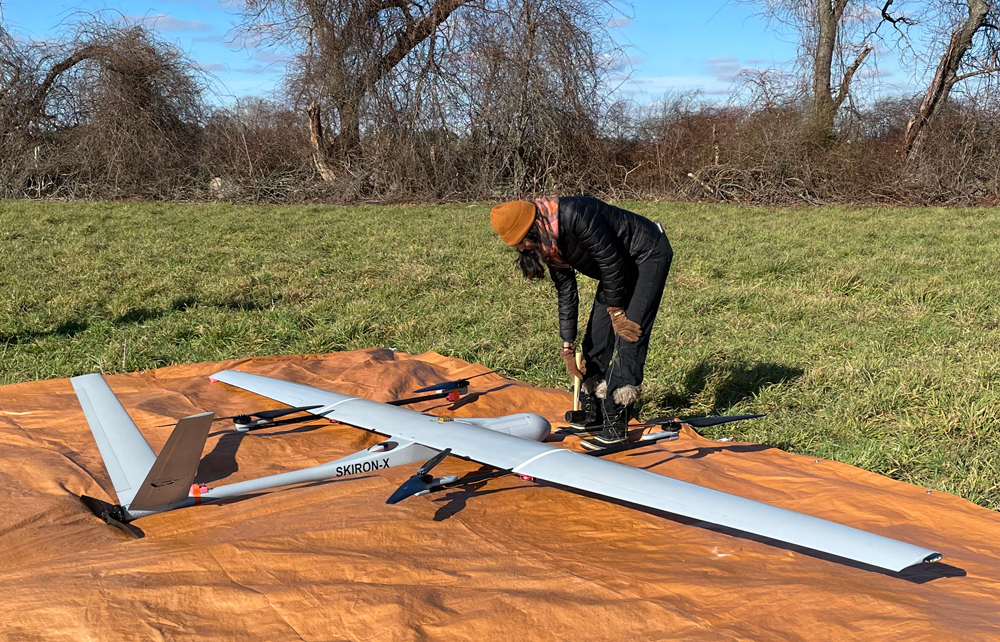
Using the eVTOL Skiron Expeditionary sUAS (SKIRON-X) aircraft from Aurora, professors at ZHAW collected calibrated data which facilitated their exploration into the structural intricacies of the virtual model.
Model-SI
ZHAW’s project titled Model-SI will assess the impact of digital twin multiphysics modeling techniques applied to eVTOL aircraft and the potential savings in flight testing cost during certification.
Funded under the European Union’s Horizon Europe program, ZHAW aims to better model the peculiar aerodynamics phenomena and structural dynamic response that are posing new challenges in the development of eVTOL aircraft configurations.
ZHAW plans to present its results to the European Union Aviation Safety Agency (EASA) later this year, with Aurora providing flight test data that will help the ZHAW team assess the accuracy of its digital model.
Aurora Collaboration
Across two days of flight testing, a SKIRON-X aircraft was outfitted with accelerometers and strain gauges on the aircraft’s wings, fuselage, and booms to provide comprehensive data on the vehicle’s accelerations and wing deformations.
ZHAW and Aurora collaborated to define flight test conditions, maneuvers, and test points in every flight condition. The collaboration covered everything from the requirement and instrumentation definition to flight test.
Aurora say that the longer range and endurance of SKIRON-X’s fixed-wing design, paired with its simpler eVTOL configuration, means that it can be used for a range of applications.
This includes research and development, firefighting, intelligence, surveillance, and reconnaissance (ISR) missions, and communications relay.
ZHAW first partnered with Aurora Swiss Aerospace in September 2023, exploring the challenges of advanced modeling and simulation for complex aircraft development, certification, and continued airworthiness.
Angelo Esposito, structures engineer at Aurora Swiss Aerospace and collaboration lead, said; “We are proud to work with ZHAW as they discover new ways to advance the future of flight. The university is dedicated to assessing digital solutions in eVTOL development and their impact on the certification approach.”
... note da SP

Tags: #EVHNews, #ZHAW, # #eVTOL, #Engineering, #Aurora Swiss Aerospace, #Education.














 English
  Deutsch
  Español
  Français
  简体中文
简体中文  Svenska
  Русский
  Português do Brasil
  العربية
  Italiano
  Polski
  日本語
日本語  한국어
한국어  हिन्दी
  Norsk nynorsk
  עִבְרִית
Altre storie
SkyDrive: Sbloccare l'accessibilità ai viaggi aerei con eVTOL compatti
L'aereo ibrido elettrico Cavorite X7 di Horizon AAM raggiunge la storica transizione al volo in avanti
Jetson ed EuroSets rivoluzionano la risposta alle emergenze UAM con la tecnologia eVTOL e soluzioni mediche avanzate in grado di salvare vite umane
Il futuro delle competizioni aeree UAM eVTOL ha fatto un coraggioso passo avanti
Il design nella sfera AAM: Il progettista senior di Frank Stephenson Design, Euan McPherson, parla degli sviluppi di AutoFlight
BETA completa le dimostrazioni di volo in tutto lo Utah
ALEF - Auto volante: Pioniere del futuro della mobilità urbana
La nuova società Gove punta sulla realtà della mobilità delle auto volanti
Jetson testa i limiti dell'agilità con il primo test di corsa aerea eVTOL con equipaggio al mondo!
Eve ottiene un prestito di $50 milioni per lo sviluppo di eVTOL
Supernal collabora con Blade per esplorare i modelli di operatori e reti
Il costruttore tedesco di aerotaxi Lilium dichiara la propria insolvenza