

The ZHAW School of Engineering conducted electric vertical take-off and landing (eVTOL) flight tests to validate its VTOL digital twin model, aiming to streamline the development of future eVTOL aircraft.
Image Credit: AAM International Media
Story By William Mackenzie
The Zurich University of Applied Sciences (ZHAW) School of Engineering has collaborated with Aurora Swiss Aerospace to validate its vertical take-off and landing (VTOL) digital twin model, which aims to streamline the development of eVTOL aircraft.
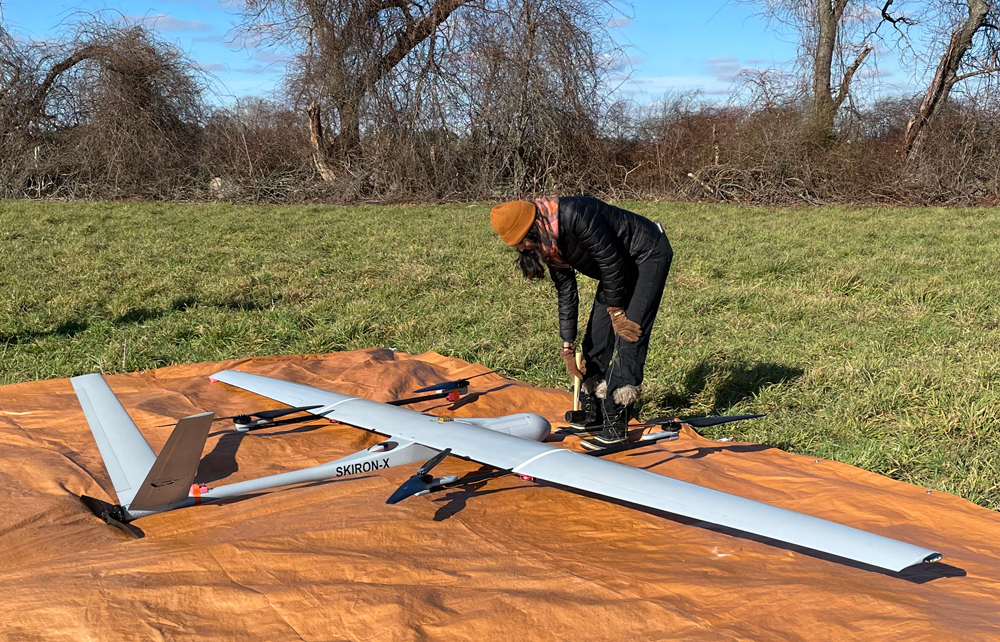
Using the eVTOL Skiron Expeditionary sUAS (SKIRON-X) aircraft from Aurora, professors at ZHAW collected calibrated data which facilitated their exploration into the structural intricacies of the virtual model.
Model-SI
ZHAW’s project titled Model-SI will assess the impact of digital twin multiphysics modeling techniques applied to eVTOL aircraft and the potential savings in flight testing cost during certification.
Funded under the European Union’s Horizon Europe program, ZHAW aims to better model the peculiar aerodynamics phenomena and structural dynamic response that are posing new challenges in the development of eVTOL aircraft configurations.
ZHAW plans to present its results to the European Union Aviation Safety Agency (EASA) later this year, with Aurora providing flight test data that will help the ZHAW team assess the accuracy of its digital model.
Aurora Collaboration
Across two days of flight testing, a SKIRON-X aircraft was outfitted with accelerometers and strain gauges on the aircraft’s wings, fuselage, and booms to provide comprehensive data on the vehicle’s accelerations and wing deformations.
ZHAW and Aurora collaborated to define flight test conditions, maneuvers, and test points in every flight condition. The collaboration covered everything from the requirement and instrumentation definition to flight test.
Aurora say that the longer range and endurance of SKIRON-X’s fixed-wing design, paired with its simpler eVTOL configuration, means that it can be used for a range of applications.
This includes research and development, firefighting, intelligence, surveillance, and reconnaissance (ISR) missions, and communications relay.
ZHAW first partnered with Aurora Swiss Aerospace in September 2023, exploring the challenges of advanced modeling and simulation for complex aircraft development, certification, and continued airworthiness.
Angelo Esposito, structures engineer at Aurora Swiss Aerospace and collaboration lead, said; “We are proud to work with ZHAW as they discover new ways to advance the future of flight. The university is dedicated to assessing digital solutions in eVTOL development and their impact on the certification approach.”
... Notizen von SP

Tags: #EVHNews, #ZHAW, # #eVTOL, #Engineering, #Aurora Swiss Aerospace, #Education













 English
  Deutsch
  Español
  Français
  简体中文
简体中文  Svenska
  Русский
  Português do Brasil
  العربية
  Italiano
  Polski
  日本語
日本語  한국어
한국어  हिन्दी
  Norsk nynorsk
  עִבְרִית
Mehr Geschichten
SkyDrive: Unlocking Air Travel Accessibility with Compact eVTOLs
Horizon AAM Hybrid-Elektroflugzeug Cavorite X7 erreicht historischen Übergang zum Vorwärtsflug
Jetson und EuroSets revolutionieren die UAM-Notfallhilfe mit eVTOL-Technologie und fortschrittlichen medizinischen Lösungen, die Leben retten können
Die Zukunft des UAM eVTOL Air Racing hat einen mutigen Schritt nach vorne gemacht
Design in der AAM-Sphäre: Der leitende Designer von Frank Stephenson Design, Euan McPherson, spricht über die Entwicklungen bei AutoFlight
BETA absolviert Flugvorführungen in ganz Utah
ALEF - Fliegendes Auto: Pionierarbeit für die Zukunft der urbanen Mobilität
Neues Unternehmen Gove setzt Bemühungen um fliegende Autos in die Tat um
Jetson testet die Grenzen der Wendigkeit mit dem weltweit ersten bemannten eVTOL Air Racing Test!
Eve sichert sich $50-Millionen-Darlehen für eVTOL-Entwicklung
Supernal geht Partnerschaft mit Blade ein, um Betreiber- und Netzwerkmodelle zu untersuchen
Deutscher Lufttaxihersteller Lilium meldet Insolvenz an