


Image Credit: Volkswagen Group
Revolution In The Underground Car Park, Volkswagen lets its EV-EVH charging Robots Loose
- Volkswagen Group Components presents a new and visionary charging concept
- Mobile robots will charge electric vehicles completely autonomously in future
- Every parking space can become a charging point
Volkswagen provides a glimpse into the future in which the search for charging stations for electric cars comes to an end. Volkswagen Group Components’ mobile charging robot takes over this task – and drives to the electric car completely autonomously.
After it is started via app or V2X communication, the mobile robot drives itself to the vehicle that needs charging and communicates with it. From opening the charging socket flap to connecting the plug to decoupling – the entire charging process occurs without any human interaction. The highlight: the mobile robot brings a trailer in the form of a mobile energy storage device to the vehicle and connects them; it then uses this energy storage device to charge the battery of the electric vehicle. The mobile energy storage device stays with the vehicle during the whole charging process. The robot, in the meantime, charges other electric vehicles. Once the charging service is complete, the robot collects the energy storage device and brings it back to the charging station.
“The mobile charging robot will spark a revolution when it comes to charging in different parking facilities, such as multistory car parks, parking spaces and underground car parks because we bring the charging infrastructure to the car and not the other way around. With this, we are making almost every car park electric, without any complex individual infrastructural measures”, summarizes Mark Möller, Head of Development at Volkswagen Group Components. “It’s a visionary prototype, which can be made into reality quite quickly, if the general conditions are right”, Möller continues. Volkswagen Group Components is researching different approaches to the assembly of charging infrastructure and has already developed several successful products. The flexible quick charging station and DC wall boxes are already part of a future charging family. Customer-oriented, intelligent and flexible approaches to charging are at the center of the research. Other innovative products such as the charging robot are currently being developed.
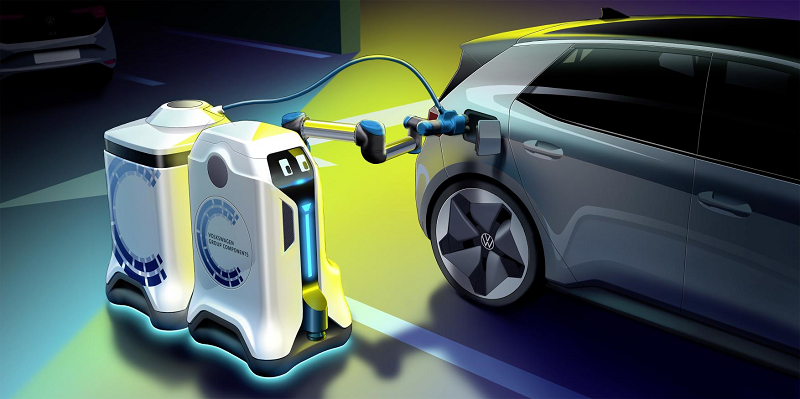


Image Credit: Volkswagen Group
Autonomous, compact and flexible
The prototype consists of a compact, self-driving robot as well as flexible and agile energy storage devices, also known as battery wagons. When fully charged, these are equipped with an energy content of around 25 kWh each. A charging robot can move several battery wagons at the same time. When called via app or V2X communication, it brings the energy storage device to the electric vehicle and connects them both autonomously. With its integrated charging electronics, the energy storage device allows for DC quick charging with up to 50 kW on the vehicle.
The robot, which can drive autonomously, is fitted with cameras, laser scanners and ultrasonic sensors. The combination of these systems not only allows the robot to carry out the charging process completely autonomously but also to move around freely in the parking area, to recognize possible obstacles and to react to these. Depending on the size of the parking area or the underground car park, several charging robots can be employed simultaneously so that several vehicles can be attended to.
Every car park can become a flexible charging point
The mobile charging robot can be put to use in various ways. It isn’t just a robot arm that connects a car to a fixed charging station. Instead, drivers have the choice to park in any available space, independent of whether a charging station is free or not. The robot brings the charging station in the form of a mobile energy storage device directly to the vehicle. For operators of different parking facilities this is a quick and easy solution to electrify every parking space. “This approach has an enormous economic potential”, says Möller. “The constructional work as well as the costs for the assembly of the charging infrastructure can be reduced considerably through the use of the robots.”
The compact design of the charging robot is perfectly suited for use in restricted parking areas without charging infrastructures, such as underground car parks. Möller continues: “Even the well-known problem of a charging station being blocked by another vehicle will no longer exist with our concept. You simply choose any parking space as usual. You can leave the rest to our electronic helper.”
The mobile charging robot is a prototype by Volkswagen Group Components, which gives an insight into the future of charging infrastructure. A possible date for the market launch of the charging robot has not been set yet.
Volkswagen engages in initiatives to establish a charging infrastructure at many levels. Together with its dealers, the company is installing a total of 36,000 charging points throughout Europe by 2025. A large proportion of these will be publicly available. Volkswagen is also launching its own wall box for home charging called the ID Charger. And as a co-founder of the IONITY joint venture, Volkswagen participates in installing 400 fast-charging parks on major European highways. Medium-term, charging an EV is to become as easy as charging a smartphone.


































更多故事
2026 年国际消费类电子产品展览会:电动汽车市场的现实情况下,汽车发展趋势倾向于人工智能
参加并探索北美最大的先进商用车技术交流会。
日产能源充电网络新增 17,800 个特斯拉超级充电站入口
电气个人防护设备 (PPE) 是一种新事物 - 由总部位于科罗拉多州的 OEL Worldwide Industries 生产
沃尔沃汽车公司将通过特斯拉超级充电站网络向超过 17,800 个 NACS 充电点开放访问权
全新欧陆 GT 展示了 eFuels 的高效性、吸引力以及碳排放量减少 30% 的非凡效果
Electrify America 和 4 Gen Logistics 在加州长滩港启动第一阶段电气化项目
保时捷 Macan Electric 将享受为期两年的 "加拿大电气化"(Electrify Canada)充电服务
大众汽车通过美国电动化充电协议提升 2025 ID.与美国电气化协会达成充电协议的 "嗡嗡 "体验
全新日产ENERGY充电网络简化电动汽车充电过程
现代汽车公司与斯柯达集团将合作开发氢能先进技术和高能效移动解决方案
第 73 届圆石滩优雅竞赛(Pebble Beach Concours d'Elegance