


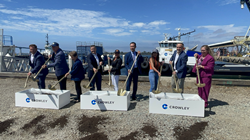
Joined by key partners and community stakeholders, Crowley and the Port of San Diego celebrated this first step toward decarbonization and reduced emissions in the San Diego community.
Building a sustainable, zero-emission port of the future requires pioneering new and innovative technology, as well as a commitment to partnerships so we can meet the needs of our communities, customers and people.
Crowley and the Port of San Diego broke ground for the shoreside charging station designed to provide clean energy for the company’s forth-coming zero-emissions tugboat, eWolf. Joined by key partners and community stakeholders, the ceremony marked a significant step forward in the industry’s journey to decarbonization and reduce emissions in the San Diego community.
The charging station is a microgrid charging facility that will allow vessels to recharge quickly while reducing peak loads on the community energy grid. It is equipped with two containerized energy storage systems provided by Corvus Energy, a leading supplier of reliable energy solutions in the maritime sector. The station is designed to operate on off-peak hours from the community’s energy grid, and it includes a solar power array to support renewable energy use. The technology is also designed to support other electric equipment and vehicle operations, if needed.
Each energy container will house battery modules with storage capacity of almost 1.5 MWh, for a total capacity of 2,990 kW. The station will be equipped with battery monitoring system, HVAC and firefighting and detection technology.
“We are proud to share in this moment with the City of San Diego to showcase an industry-first, shoreside charging station at the Port of San Diego,” said Matt Jackson, vice president of advanced energy for Crowley. “Building a sustainable, zero-emission port of the future requires pioneering new and innovative technology, as well as a commitment to partnerships so we can meet the needs of our communities, customers and people.”
“We are proud to work with Crowley and are grateful they chose San Diego Bay as home of the first all-electric tugboat in the United States,” said Chairman Rafael Castellanos, Port of San Diego Board of Port Commissioners. “Their commitment to sustainability in the maritime industry directly aligns with our own efforts and goals to reduce emissions and improve public health in our communities while also supporting efficient and modern maritime operations.”
The eWolf and its shoreside solar charging station are the result of a partnership among Crowley, the San Diego County Air Pollution Control District, the California Air Resources Board, the Port of San Diego, the U.S. EPA and the U.S Maritime Administration.
The eWolf, under continuing construction, is a crucial component of the shared commitment between Crowley and its federal and local partners to invest and develop emissions-free technology. It is designed to operate at its full performance capabilities while running entirely on electricity.


































Más historias
NISSAN ENERGY Charge Network añade acceso a 17.800 Supercargadores Tesla
Electrify America y 4 Gen Logistics lanzan la primera fase del proyecto de electrificación del puerto de Long Beach, California
El Porsche Macan Eléctrico recibe dos años de recarga incluida de Electrify Canada
Volkswagen mejora la experiencia ID. Buzz con el acuerdo de recarga Electrify America
La nueva red NISSAN ENERGY Charge simplifica la recarga de vehículos eléctricos en movimiento
Volvo Cars se asocia e invierte en Breathe para la próxima generación de carga rápida
El inversor de aviación de carburo de silicio de última generación ZeroAvia funciona con un rendimiento líder mundial
El Aeropuerto Regional Golden Triangle de Mississippi, BETA Technologies y Avflight establecen su primer cargador eléctrico en pista
J+ BOOSTER 2 lleva la solución de chispa tubular industrial a SEMA 2023
Hyundai Motor Group y LG Energy Solution invertirán $2B adicionales en el condado de Bryan
Ford Pro amplía sus soluciones de carga con una nueva gama de cargadores para clientes comerciales
GM pone la tecnología de carga bidireccional del vehículo a la vivienda a disposición de su cartera de próximos vehículos eléctricos basados en Ultium.