


New Hybrid Technology To Prevent Icing On Aircraft and Drones
The testing conducted at NASA’s Icing Research Tunnel has moved the hybrid technology to a readiness level of 6 (TRL6).

Invercon and NEI Corporation’s newly developed de-icing system tested successfully at NASA’s Icing Research Tunnel and was advanced to a Technology Readiness Level of 6. The hybrid technology is designed to prevent ice accretion on aircraft and drones.
Invercon Inc. and NEI Corporation have recently announced that their newly developed de-icing system was tested successfully at the NASA Glenn Research Center’s Icing Research Tunnel. The test was witnessed by engineers and scientists at the Research Center, as well as from the industry. The Invercon-NEI team met the objective of demonstrating a low power anti-ice system in conjunction with NEI’s NANOMYTE® SuperAi anti-ice coating that prevents ice accretion on the leading edge of an airfoil. The test was performed on a full-size airfoil under simulated in-flight conditions, following nearly two years of development and laboratory testing.
All commercial aircraft have a built-in ice protection system, which could be either a thermal, thermo-mechanical, electro-mechanical, or pneumatic system. A common issue with de-icing devices is that they consume substantial power. Aircraft generally look to reduce power consumption, and with the advent of battery-powered aircraft, mechanisms or features that reduce power consumption are critically important. Icing presents a particular challenge for commercial and military drones, where ice can build up on the wings and propellers and result in crashes. In fact, the current practice is not to fly drones when icing conditions are predicted. Applying a passive anti-ice coating that functions synergistically with an active de-icing device is an attractive hybrid approach, which the team of NEI and Invercon has now demonstrated on full-scale prototypes.
NEI’s NANOMYTE® SuperAi anti-ice coating is a durable coating, suitable for permanent application. The coating leads to a lubricating surface that drastically reduces the adhesion strength of ice – by as much as 80%, compared to bare polished aluminum. The coating is usually applied by spraying, like conventional painting. NANOMYTE® SuperAi coating is available for commercial use.
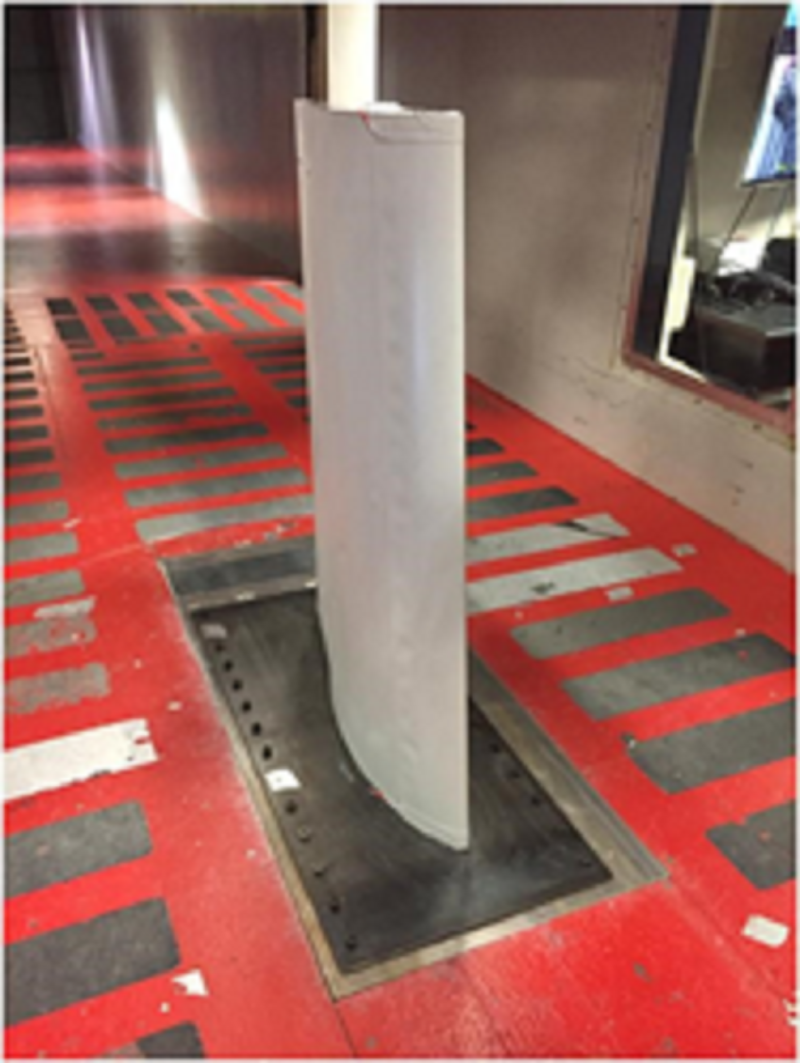
Invercon has developed a new, retrofittable, electro-pneumatic deicing system that combines the most attractive aspects of several existing systems without their associated drawbacks. The Invercon system requires remarkably low power (≤ 2.5 kW), is retrofittable on any airfoil, adds very little weight (~50 lbs.), and is durable enough to last the life of the aircraft once retrofitted. Importantly, the system looks, feels, and acts like the original leading edge and can provide millions of maintenance-free deicing cycles. The entire wing test section (Figure 1) was coated with NANOMYTE® SuperAi.
Invercon successfully completed icing tests of the electro-pneumatic deicing system at NASA Glenn’s Icing Research Tunnel (IRT) under a full range of representative icing conditions. The Invercon system was able to provide continuous deicing of the wing section leading edge over all the test conditions ranging from temperatures of -3°C to -20°C with various liquid water content. Typically, the system allows ice to accrete for about 2 minutes and then completely sheds upper and lower surface ice upon system activation.
The testing at NASA’s IRT, which is the longest running icing facility in the world, has moved the hybrid technology to a readiness level of 6 (i.e., TRL6), which is a scale used by NASA and Department of Defense to gauge the maturity level of a technology.
Both NEI Corporation and INVERCON LLC are grateful for the financial support extended by the Small Business Innovation Research Program from the Air Force and NASA. The SBIR program funds product development efforts that reduce concepts to practice and then to prototypes, thereby reducing technology risk. The successful full-scale demonstration by the team has advanced a new technology to a state of commercial readiness.
정보 NEI Corporation:
NEI Corporation is an application-driven company that utilizes nanotechnology to develop and produce advanced materials. The company’s core competencies are in synthesizing nanoscale materials and prototyping products that incorporate the advanced materials. NEI offers an array of Advanced Protective Coatings for metal and polymer surfaces. The coatings have tailored functionalities, such as anti-corrosion, self-healing, scratch resistance, ice-phobic, and self-cleaning.
정보 Invercon LLC:
Invercon’s mission is to develop advanced technologies that enable revolutionary leaps forward in aircraft performance and safety. For rotorcraft, these include centrifugally powered, pneumatic actuation systems that can actively trim rotors and de-ice rotor blades using almost no power or weight, resulting in significantly improved performance and safety. For fixed wing aircraft, Invercon has developed extremely low power deicing solutions using a novel electro-pneumatic actuation approach.





























더 많은 스토리
AAM 분야의 디자인: 프랭크 스티븐슨 디자인의 수석 디자이너, 유안 맥퍼슨이 오토플라이트의 개발에 대해 이야기합니다.
전기 개인 보호 장비(PPE)의 중요성 - 콜로라도에 본사를 둔 OEL 월드와이드 인더스트리가 생산합니다.
지니어스 뉴욕, 드론 스타트업에 1억 4천 3백만 달러 투자
2024년 11월 25일부터 27일까지 열리는 드론테크 아시아 국제 컨퍼런스에서 드론 애플리케이션의 미래를 살펴보세요.
패러렐 플라이트 테크놀로지스, 알파 드론으로부터 하이브리드 헤비 리프트 UAV인 파이어플라이 여러 대 주문 받아
제로아비아와 플라이브이, 유럽 전역의 청정 온디맨드 비행을 위한 파트너십 체결
제로아비아의 최첨단 실리콘 카바이드 항공 인버터, 세계 최고의 성능으로 가동 중
Golden Triangle Regional Airport Mississippi, BETA Technologies, & Avflight Establishes Its First Electric Airside Charger
H2FLY And Partners Complete World’s First Piloted Flight of Liquid Hydrogen Powered Electric Aircraft
ASKA A5 플라이 eVTOL, FAA 형식 인증 절차 진전 – 시제기, 특별 감항 인증 획득
데스티누스, 파리 르 부르제 에어쇼에서 수소연료전지 초음속 데모기 데스티누스 3 공개
2023년 6월 19일부터 25일까지 르 부르제에서 열리는 제54회 국제 파리 에어쇼에 참가하는 제로아비아